The Refined Studio: How to Design a Creative Workspace at Home Without Compromising the Elegance of the Whole
Creative work is inherently material. It produces evidence of itself — sketchbooks left open, paint in various stages of drying, fabric swatches pinned to a board, half-finished prototypes claiming the nearest available surface. This is not a failure of discipline; it is simply the nature of making things. The tools of a creative practice are, by definition, in use.
For homeowners who take both their creative work and their interiors seriously, this presents a genuine design problem. How does one accommodate the honest mess of a working studio within a home that aspires to elegance? How does the drafting table coexist with the linen sofa? Where does the bolt of fabric live when it is neither in use nor put away?
The answer is not to hide the work entirely — that approach produces spaces that feel sterile and, ultimately, function poorly. The answer is to design the workspace with the same intention applied to every other room in the home: to make deliberate choices about what is seen, what is stored, and how the two relate to each other.
Start With the Room's Existing Character
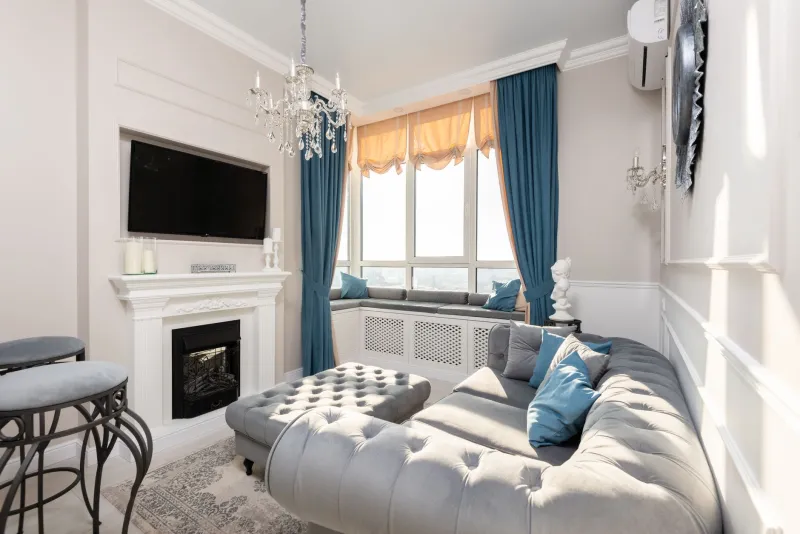
Before introducing a single piece of studio furniture or storage solution, spend time understanding the room's existing design language. A creative workspace that fights its architectural context will always feel like an intrusion. One that responds to it — borrowing its proportions, its palette, its material sensibility — will feel like it belongs.
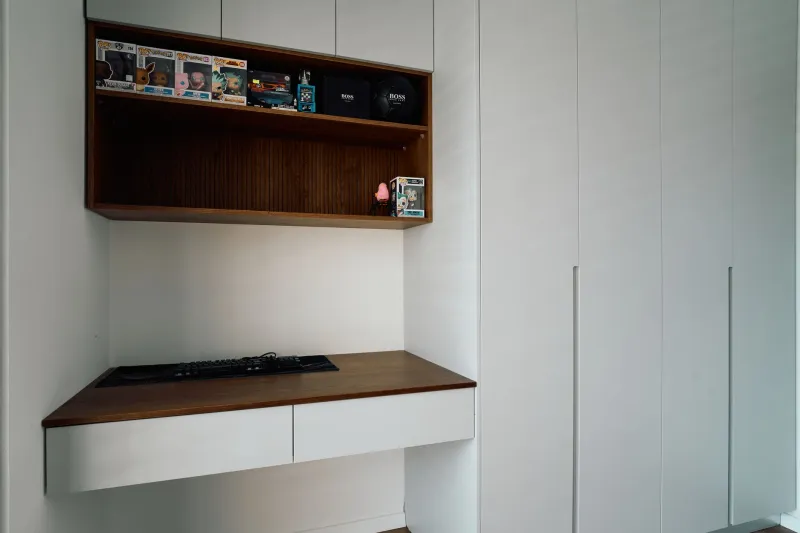
In a home with warm wood tones and traditional detailing, studio storage in painted wood with simple hardware will integrate far more gracefully than industrial metal shelving, however practical the latter might be. In a more contemporary home with clean lines and a neutral palette, built-in cabinetry that reads as architectural rather than functional can absorb an enormous amount of creative material without disrupting the room's visual calm.
This is not about disguising the workspace. It is about designing it so that it participates in the room's aesthetic rather than contradicting it.
The Case for Concealed Storage — Done Well
There is a meaningful distinction between storage that conceals and storage that merely hides. The former is designed with intention; it considers what is being stored, how frequently it is accessed, and how the storage itself looks when closed. The latter is simply a door pulled over disorder.
For a home creative space, concealed storage works best when it is built around the specific rhythms of the work being done. A painter who works daily needs different access patterns than a quilter who works on weekends. A writer who requires reference materials at arm's reach has different organizational needs than a ceramicist whose materials are heavy and seldom moved. Design the storage around the actual practice, not around a generic idea of what a studio contains.
Cabinets with solid doors — particularly those that align with the room's existing millwork — are among the most versatile solutions available. In a room that already has built-ins, commissioning additional cabinetry to match can be surprisingly cost-effective relative to the visual coherence it creates. For renters or those who prefer not to build in, armoires and sideboards in complementary finishes can absorb a remarkable quantity of creative material while presenting a composed face to the room.
Drawer inserts, labeled bins, and divided trays within closed storage keep the interior organized and ensure that concealment does not simply relocate the chaos. The inside of a cabinet, like the inside of a closet, deserves a system.
Mobile Solutions for Flexible Spaces
Not every home has a room to dedicate exclusively to creative work. Many of the most elegant home studios in the country occupy corners of living rooms, alcoves off dining areas, or dual-purpose guest rooms. In these situations, mobility becomes a design asset rather than a compromise.
Rolling carts in materials that complement the room — painted wood, woven rattan, powder-coated steel in a finish that reads as warm rather than industrial — can hold an entire working kit and be moved out of sight when not in use. A worktable on locking casters can serve as a desk during working hours and be rolled to the room's perimeter when the space needs to function otherwise. Folding surfaces mounted to the wall on piano hinges provide a generous work area that disappears entirely when not deployed.
The key to making mobile solutions feel intentional rather than improvised is finish quality and material consistency. A rolling cart in the same painted finish as the room's trim, or a folding surface in the same wood species as the flooring, reads as designed. The same cart in raw metal or unfinished plywood reads as temporary — and temporary is the quality most at odds with the elegance we are working toward.
Framing the Work as Part of the Room's Narrative
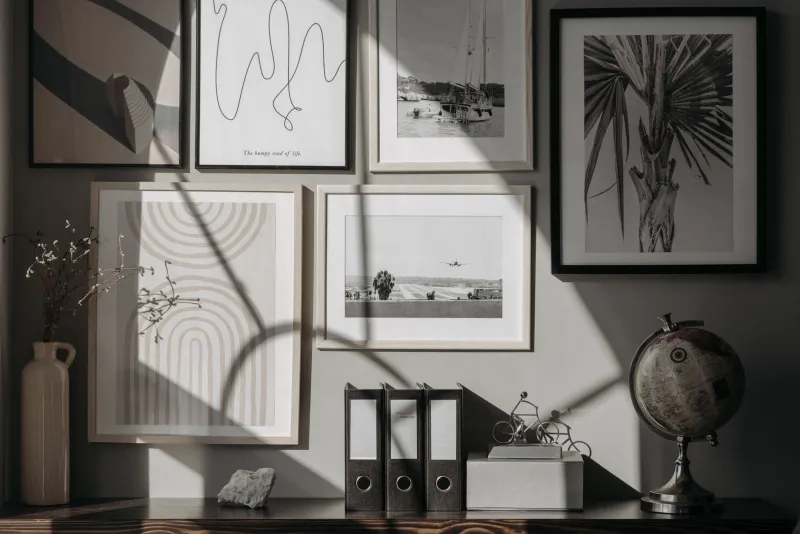
Some creative materials are, frankly, beautiful. A collection of ceramic vessels in progress. A wall of fabric samples arranged by color family. A shelf of reference books, art monographs, and hand-labeled sketchbooks. These are not obstacles to an elegant room — they are potential contributors to one, provided they are edited and arranged with the same care as any other display.
The principle here is curation rather than accumulation. A work-in-progress displayed on a dedicated easel or mounted on a picture rail becomes a piece of art in its own right — evidence of a creative life rather than evidence of disorder. A collection of tools arranged by type and size in an open tray or on a pegboard with consistent spacing reads as intentional. The difference between a cluttered surface and a composed one is rarely the quantity of objects; it is the degree of attention paid to their arrangement.
Consider designating one area of the workspace — a single shelf, a single wall section, a single tray — as the curated display zone where work-in-progress and favorite tools are presented with intention. Keep everything else behind closed doors. This approach gives the creative life of the home a visible, dignified presence without allowing it to overwhelm the room.
The Elegance of a Well-Equipped Space
There is a final point worth making, and it runs counter to the assumption that elegance and function are in tension. The most beautiful workspaces — the kind that appear in the studios of accomplished artists, architects, and designers — are not beautiful despite being well-equipped. They are beautiful because of it. The right tool in the right place, the well-organized shelf, the surface kept clear for the work at hand: these are expressions of respect for the practice, and that respect is itself a form of elegance.
A creative workspace designed with genuine intention — one that accommodates the real demands of the work while participating gracefully in the home's broader aesthetic — does not compromise the home. It completes it.