The Discipline of Subtraction: How Removing the Right Things Transforms a Home
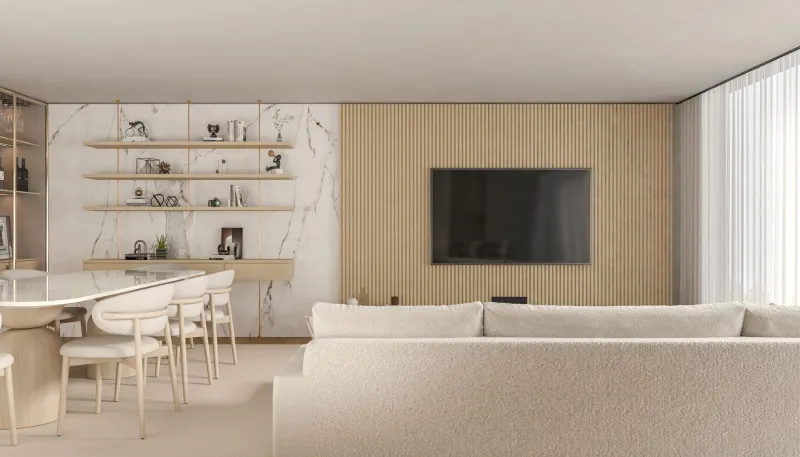
There is a particular kind of room that stops you at the threshold. Not because it dazzles with layered accessories or announces itself through bold gesture, but because it possesses an unusual quality of calm—a sense that everything within it belongs precisely where it is, and that nothing is missing. What most visitors cannot immediately identify is that this feeling rarely comes from what has been added. It comes, almost entirely, from what has been removed.
The design principle of subtraction is among the most misunderstood in residential interiors. American homes, shaped by a cultural instinct toward abundance and self-expression through objects, frequently suffer from the opposite problem: too much of everything, arranged without a governing logic. The result is spaces that feel neither restful nor refined, regardless of the quality of individual pieces within them. The solution is not a larger home. It is a more disciplined one.
Why Accumulation Works Against Elegance
Human beings are natural collectors. We attach meaning to objects—the lamp inherited from a grandmother, the art print purchased on a trip to Santa Fe, the decorative bowl that seemed essential in the store and now occupies a shelf without purpose. Over time, these accumulations layer upon one another until a room becomes less a curated environment and more an archive of decisions made across different years, different moods, and different design sensibilities.
The psychological effect of visual clutter is well documented. Environments dense with objects demand continuous low-level cognitive processing—the brain must constantly negotiate competing focal points, unresolved compositions, and surfaces without rest. The result is a subtle but persistent sense of fatigue that many homeowners attribute to stress or lifestyle, when the origin is, in fact, spatial.
Elimination addresses this directly. When a room contains only what it genuinely requires, the eye moves through the space with ease. Attention settles naturally on what is beautiful. The room breathes.
The Framework: What Stays, What Goes
Curation is not the same as minimalism. The goal is not to reduce a room to its structural bones or to strip it of warmth and personality. The goal is intentionality—ensuring that every object present earns its place through function, beauty, or meaningful narrative. The following framework offers a practical structure for making those determinations.
Ask what the object does. Every piece in a room should perform at least one of three roles: it should be used, it should be beautiful, or it should carry personal significance. Objects that fulfill none of these criteria are candidates for removal. Objects that fulfill only one deserve scrutiny. Objects that fulfill two or more have earned their place.
Assess the visual weight. Even a single shelf can become overwhelming if every inch is occupied. Consider not just individual objects but their collective density. A grouping of three well-chosen items reads as composition. A grouping of eleven reads as storage.
Evaluate the room as a whole, not in parts. The most common mistake in home editing is assessing objects individually rather than in relationship to one another. A chair may be beautiful in isolation and yet disruptive within a specific room. Step back. Photograph the space. Distance clarifies what proximity obscures.
Honor the room's function. A living room intended for quiet conversation does not require the same visual energy as a family room designed for active daily life. Calibrate the density of objects to the emotional register the room is meant to sustain.
Case Studies in Thoughtful Subtraction
Consider a dining room in a Chicago townhouse, originally furnished with a twelve-piece china cabinet display, a buffet covered in silver serving pieces, framed artwork on three of four walls, and a centerpiece arrangement that competed with the chandelier above it. The room was not poorly furnished—individual pieces were of genuine quality—but it communicated nothing coherently. Meals felt performative rather than convivial.
The intervention involved removing the buffet entirely, relocating the china display to a single dedicated cabinet in an adjacent hallway, reducing the wall art to one large-format piece on the primary wall, and replacing the elaborate centerpiece with a single low vessel of seasonal greenery. The chandelier, previously lost in the visual competition, became the room's defining architectural element. The dining experience shifted. Guests lingered longer. The room had found its purpose.
A similar transformation occurred in a Phoenix living room where a sectional sofa, three accent chairs, two side tables, four floor lamps, and an assortment of decorative objects had rendered the space simultaneously overcrowded and strangely impersonal. Removing one accent chair, both side tables, two of the floor lamps, and reducing the decorative objects by roughly sixty percent produced a room that felt larger, more composed, and—paradoxically—more welcoming. Less furniture created more space for life to occur within it.
The Emotional Challenge of Letting Go
It would be dishonest to present subtraction as a purely rational exercise. For most homeowners, objects carry emotional weight that resists logical assessment. The challenge is not identifying what to remove—most people know, intuitively, which pieces do not belong—but granting themselves permission to act on that knowledge.
One useful reframe: removing an object from a room is not the same as discarding it from your life. Beloved pieces that do not serve a particular space can be stored, donated to someone who will genuinely use them, or relocated to a room where they contribute more meaningfully. The goal is to give every object the dignity of the right context, rather than allowing everything to compete for attention in a single overcrowded environment.
Restraint as a Form of Generosity
The edited home is, at its core, an act of generosity—toward the people who live within it, toward the objects that remain, and toward the space itself. When a room is freed from the burden of containing everything, it becomes capable of communicating something specific: a point of view, a quality of light, a sense of ease that no amount of addition can manufacture.
This is the quiet philosophy that underlies the most elegant interiors. Not the accumulation of beautiful things, but the courage to choose among them—and the discipline to stop.
The rooms that endure, that feel timeless rather than dated, that guests remember long after they have left, are almost always rooms from which someone had the wisdom to take something away.