The Moment Before the Room: How to Design the Threshold That Shapes Every First Impression
There is a fraction of a second — before a guest has fully entered, before they have formed a conscious thought — when a room announces itself. The light hits at a particular angle. A scent drifts forward. The eye lands on something: a wall, a window, a piece of furniture positioned either deliberately or by default. That fraction of a second is, in many respects, the most important design moment in the entire space.
And yet it is almost always the last thing considered.
Most homeowners think about rooms as collections of walls, furnishings, and finishes. Four walls, a floor, a ceiling — the familiar geometry of interior life. What rarely enters the conversation is the fifth element: the threshold itself. The entry moment. The precise view and experience a person encounters the instant they step from one space into another. Getting this right does not require a renovation. It requires intention.
Why First Impressions Are Structural, Not Superficial
Psychologists have long documented the primacy effect — the human tendency to weight initial information disproportionately when forming lasting judgments. Rooms are no different. When a person enters a space and immediately encounters visual disorder, awkward proportions, or a sightline that terminates in something mundane, the emotional register of that room is already compromised, regardless of what lies beyond.
Conversely, a room that presents itself gracefully at the threshold — where the eye is guided, the scale feels resolved, and the atmosphere is quietly legible — earns a kind of goodwill that carries through the entire experience of the space. Guests feel welcomed without knowing precisely why. Residents feel settled the moment they return home.
This is not coincidence. It is the result of deliberate spatial thinking applied to the entry moment.
The Sightline as a Design Tool
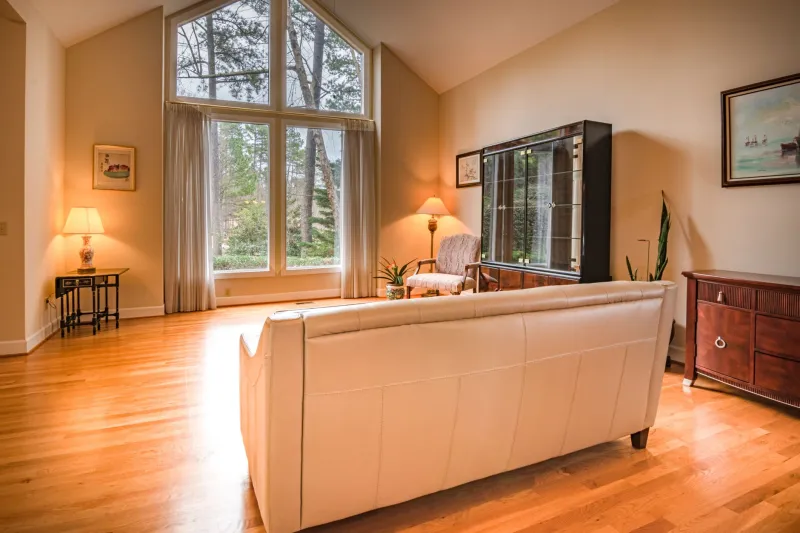
Begin by standing at the doorway of any room in your home and looking straight ahead. What does your eye land on first? Is it something beautiful — a piece of art, a considered arrangement, a view through a window? Or does it land on the back of a sofa, the edge of a television cabinet, or a wall interrupted by nothing in particular?
The primary sightline from a room's entry point is, effectively, a promise. It tells visitors what kind of room this is and how much care has been invested in it. A designer's first instinct upon entering a new project is almost always to trace this line and ask: what is this room offering, and is that offer worthy of the space?
In practice, improving a sightline rarely requires moving walls. It often means repositioning a single piece of furniture so that the entry view terminates in something meaningful. A console table centered on the far wall. A framed print hung at precise eye level. A lamp that draws light toward the focal point rather than away from it. These adjustments cost relatively little and return a great deal.
Proportion and the Sense of Welcome
Beyond the visual, there is the question of scale. A room that feels immediately comfortable upon entry is one where the proportions at the threshold are in harmony with the human body. Doorways that open onto furniture placed too close create a sense of compression. Entries that reveal a vast, underfurnished expanse can feel equally disorienting — grand in theory, cold in practice.
The goal is what designers sometimes call a resolved threshold: a transition point where the room's scale reads as intentional within the first step. This often means placing an anchor piece — a sofa, a rug, a significant table — at a distance from the entry that allows the eye to settle before traveling further. The room should feel like it has been composed to receive you, not merely assembled around a floor plan.
In open-plan American homes, where rooms flow into one another without the natural framing of a doorway, this challenge becomes more nuanced. Here, designers frequently use rugs, lighting changes, or ceiling treatments to create implied thresholds — moments of visual pause that signal a shift in function and atmosphere, even in the absence of a physical wall.
Sensory Cues Beyond the Visual
A thoughtfully designed entry moment engages more than the eyes. The temperature of light — warm versus cool — communicates comfort or alertness before any object registers. A room that greets you with warm, layered illumination reads as intimate and welcoming. One that opens to harsh overhead lighting, however well-furnished, communicates something closer to utility.
Scent, too, plays a quiet but powerful role. Rooms that carry a consistent, understated fragrance — whether from natural materials, fresh flowers, or a considered candle — create a sensory memory that reinforces the emotional impression of the space. This is not about perfuming a room aggressively; it is about ensuring that the first breath taken inside communicates care.
Sound is often overlooked entirely. A room with hard surfaces and no acoustic softening can feel unwelcoming even before the visual has fully registered. Rugs, upholstered furniture, and fabric window treatments absorb sound in ways that make a room feel inhabited and considered rather than echoic and unfinished.
Practical Strategies for Existing Homes
For homeowners working within the constraints of an existing floor plan — which is to say, most of us — redesigning the entry moment is a practical exercise, not a theoretical one. Several approaches consistently yield meaningful results.
Audit your entry views first. Before making any purchasing decisions, photograph each room from its primary entry point. Review those images as a stranger would. Identify the first object the eye meets and evaluate whether it earns that position.
Reposition before you replace. Many entry moments can be dramatically improved by moving existing pieces rather than acquiring new ones. A chair rotated fifteen degrees, a lamp relocated to the far corner, a rug shifted to better frame the room's center — these adjustments are free and frequently transformative.
Invest in the focal point. Whatever the entry sightline terminates in deserves your best attention. If that means one excellent piece of art on an otherwise simple wall, that investment will pay returns every time the room is entered.
Address the light at the threshold. Consider whether a dimmer switch, a table lamp, or a repositioned floor lamp could warm the entry moment without a larger renovation. In many homes, this single change alters the character of a room more profoundly than any furniture purchase.
Create a sense of arrival in open plans. If your room lacks a defined entry, introduce one through a change in ceiling height, a pendant light that marks the transition, or a console table positioned to suggest a boundary between the entry path and the living area proper.
The Room as a Host
At its best, a well-designed room does not wait for its occupants to discover it. It steps forward. It offers something — a view, a quality of light, a sense of proportion — the moment a person arrives. This quality, which feels almost like hospitality when experienced, is not accidental. It is the result of a designer asking a simple question at the outset: what will someone see and feel the instant they enter this space, and is that experience worthy of everything that follows?
The threshold is not a formality. It is the room's opening statement. And like any well-crafted introduction, it sets the terms for everything that comes after.