Hinged, Sliding, or Hidden: How Your Doors Shape the Story of Every Room
There is a moment, common to nearly every design consultation, when a client gestures toward a beautifully curated room and says, something still feels off. The furniture is scaled correctly. The lighting layers well. The palette is cohesive. And yet the room resists completion. In a surprising number of these cases, the answer is standing right in front of everyone — literally. The door.
Doors are among the most frequently touched and least thoughtfully chosen elements in any American home. They arrive with the builder's package, hang in their frames for decades, and are rarely questioned until a renovation forces the issue. Yet every door you select — its material, proportion, hardware, and swing — communicates something deliberate or accidental about the spaces it connects. Treating doors as afterthoughts is a missed opportunity of considerable consequence.
The Door as a Design Statement
Architects have long understood what interior designers sometimes forget: a door is not merely a privacy mechanism. It is a threshold, a framing device, and a visual anchor. In older American homes — think the grand Colonial Revivals of New England or the Craftsman bungalows of the Pacific Northwest — doors were designed with the same vocabulary as the millwork, the mantels, and the casing. They belonged to the room. They told the same story.
Modern construction has largely severed that relationship. The hollow-core, flat-panel door became the default not because it serves design well, but because it serves budgets efficiently. The result is a generation of homes where beautifully appointed rooms are interrupted by doors that look borrowed from a different building entirely.
The first step toward correcting this is recognizing that your doors carry narrative weight. A solid wood door with a raised panel profile reads as traditional and substantial. A door with glass lites draws light through a space and implies openness. A flush door, properly proportioned and finished, reads as clean and contemporary. None of these choices is inherently superior — but all of them are choices, and choosing with intention produces rooms that feel resolved.
Proportion and Placement: The Details That Determine Elegance
Beyond style, proportion is perhaps the single most underestimated factor in door design. Standard residential doors in the United States measure 80 inches in height — a dimension established for practicality, not beauty. In rooms with nine-foot or higher ceilings, this proportion can feel stunted, creating an awkward visual gap between the top of the door frame and the ceiling plane above it.
Designers working at the higher end of residential projects routinely specify 8-foot or even 9-foot doors in rooms with elevated ceilings. The effect is immediate and almost impossible to articulate without seeing it directly: the room simply breathes differently. The vertical line of the door aligns with the architectural ambition of the space, and the eye moves upward rather than stopping abruptly at a horizontal seam.
Placement matters equally. Doors positioned on axis with windows, fireplace surrounds, or opposing doorways create a sense of visual order that registers as calm and considered, even to guests who cannot identify why the room feels so composed. Off-axis doors — particularly those that open awkwardly into a room's primary seating arrangement — introduce a subtle friction that accumulates over time.
Hardware as Punctuation
If the door is a sentence, the hardware is its punctuation. A beautifully proportioned door fitted with a generic builder-grade lever handle is the design equivalent of a well-constructed argument that trails off mid-thought. The hardware you choose signals whether the door was designed or merely installed.
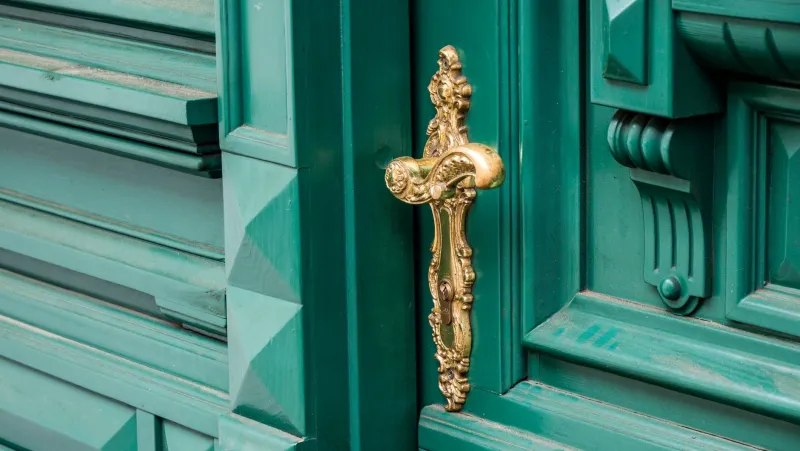
This does not require extravagance. A simple, well-cast solid brass knob in an unlacquered finish, allowed to develop its own patina over time, brings far more character to a door than an ornate handle in a finish that has no relationship to the rest of the room's metal tones. Consistency of finish — aligning door hardware with light fixtures, cabinet pulls, and plumbing fixtures — is one of the most effective and frequently overlooked tools for creating rooms that feel cohesive rather than assembled.
For transitional and contemporary interiors, long lever handles in a matte black or brushed nickel finish can provide a clean, architectural line. For traditional spaces, a mortise lockset with a crystal or porcelain knob can add a layer of historical authenticity that no amount of decorative accessories can replicate.
The Case for the Unexpected Door
Some of the most memorable residential interiors in the country use doors as deliberate focal points rather than neutral connectors. A lacquered door in a saturated, contrasting color — navy in a pale gray hallway, deep forest green in a cream-toned dining room — functions as a piece of art that also happens to open. Barn-style sliding doors, when executed with quality hardware and genuine material, bring warmth and movement to spaces that might otherwise feel static.
Hidden doors — those paneled to match the surrounding wall, fitted with touch latches and no visible hardware — create a quality of mystery and intentionality that elevates any room they inhabit. Used thoughtfully in libraries, studies, or primary suites, they suggest that the designer considered not only what is seen but what is concealed, and that the boundary between the two was drawn with care.
A Framework for Reconsidering Your Doors
For homeowners ready to examine their doors with fresh eyes, we recommend beginning with three questions.
First: does this door belong to the room? Consider whether its profile, material, and finish share a vocabulary with the surrounding architecture, or whether it reads as a foreign object inserted into an otherwise resolved space.
Second: does the proportion serve the ceiling height? If your ceilings exceed eight feet and your doors remain at the standard 80-inch height, upgrading door height — even in a selective renovation — can transform the perceived scale of the entire room.
Third: does the hardware complete the thought? Replacing builder-grade hardware is among the most cost-effective design improvements available. A set of quality knobs or levers, consistently finished across a floor plan, can unify a home's interior language in ways that far exceed the investment.
Doors are, in the end, one of the few design elements that every person in your home touches every single day. They deserve the same consideration you give to any surface, any fixture, or any piece of furniture. Design them with intention, and they will tell precisely the story you wish your home to tell.