The Architecture of Atmosphere: Building Richness in a Room Without Crossing Into Chaos
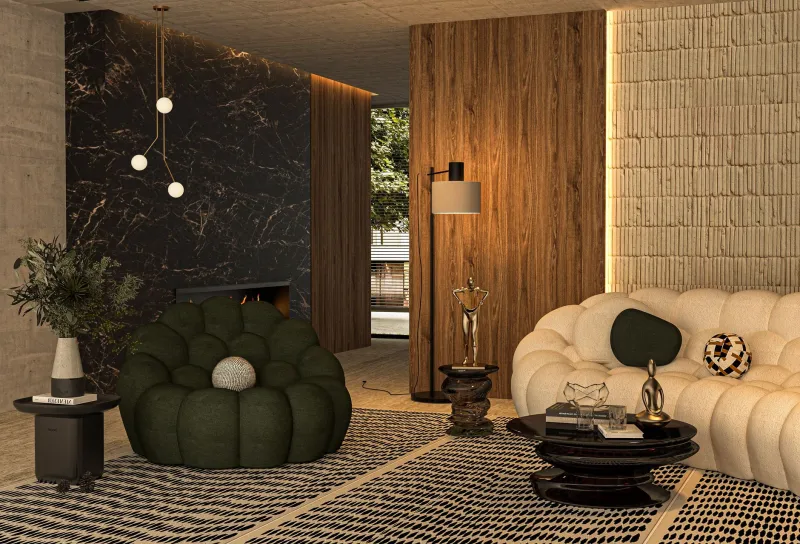
There is a particular kind of room that is difficult to leave. You settle into it, and something — you cannot quite name it — makes you feel simultaneously stimulated and at ease. The light seems kinder. The surfaces seem to belong to one another. Everything is interesting, yet nothing demands too much. If you have ever experienced this and wondered what produced it, the answer is almost certainly layering: one of the most sophisticated and least understood principles in interior design.
Layering is not decoration in the conventional sense. It is not the act of adding objects until a room feels full. It is, rather, a cumulative process — the careful introduction of textures, tones, patterns, and materials in an order and proportion that creates depth without disorder. Done well, it is invisible. Done poorly, it announces itself as clutter.
Understanding why this distinction matters requires a brief consideration of how the human eye actually processes a room.
How the Eye Reads a Space
When a person enters a room, the eye does not take in every detail simultaneously. It moves — scanning for contrast, pausing at focal points, then settling into a rhythm of exploration. A room that is visually flat offers nothing to hold the gaze. A room that is visually chaotic overwhelms the scanning process entirely, triggering a low-grade discomfort that most people attribute vaguely to the room feeling "busy" or "off."
The goal of strategic layering is to choreograph that scan. You want the eye to travel, to discover, and ultimately to rest — satisfied that it has found something worth finding at each stopping point. This is why a room that has been thoughtfully layered feels curated rather than cluttered, even when it contains a significant number of elements.
The psychology at work here is straightforward: human beings find pleasure in pattern recognition. When a room presents related but varied elements — a linen sofa, a woven jute rug, a rough-hewn wooden side table — the brain perceives a coherent family of materials and experiences a quiet satisfaction. When unrelated elements compete for dominance, that satisfaction is replaced by cognitive friction.
The Foundation: Starting With Texture Before Color
Many designers begin with color, and color is certainly important. But in a layered interior, texture is the more foundational consideration — because texture is what gives color its character.
Consider two rooms painted the same shade of warm white. In the first, the walls are smooth, the sofa is a flat cotton weave, and the floors are polished hardwood. In the second, the walls have a subtle plaster texture, the sofa is upholstered in a nubby bouclé, and the floors are wide-plank oak with visible grain. Both rooms share a color palette, but only the second has depth. The texture is doing the heavy lifting.
A practical approach is to think in terms of three texture registers: coarse, medium, and fine. A room that contains only one register reads as flat. A room that contains all three — perhaps a chunky knit throw, a smooth marble surface, and a sheer linen curtain — achieves a tactile complexity that is genuinely pleasurable, even for those who never consciously register why.
Introducing Pattern: The Rule of Varied Scale
Pattern is where many well-intentioned interiors go wrong. The instinct, when selecting textiles and wallcoverings, is often to choose patterns that match — florals with florals, geometrics with geometrics. But matching is not the same as harmonizing, and it is harmony that creates elegance.
The principle that professional designers rely upon is scale variation. When patterns of different scales share a common color or visual tone, they coexist without competing. A large-scale botanical print on a single accent chair, paired with a small geometric repeat on throw pillows and a barely-there woven stripe on a rug, creates a conversation rather than a collision. Each pattern occupies its own visual territory while contributing to a unified whole.
A useful self-editing test: if you can identify every pattern in a room within the first ten seconds of entering it, there may be too many patterns of similar scale. The goal is for some elements to reveal themselves only upon closer inspection — that quality of discovery is precisely what makes a room feel inexhaustible rather than immediately consumed.
Material as Narrative
Beyond texture and pattern, the materials themselves carry meaning — and in a layered interior, those materials should tell a coherent story. This does not mean that every surface must match. It means that the materials in a room should feel as though they belong to the same world.
A room anchored by natural materials — stone, wood, linen, leather — can absorb a metal accent, a lacquered surface, or a glass element without losing its sense of narrative. The key is proportion. Natural materials in abundance, refined or industrial materials as punctuation. When that ratio inverts, the room begins to feel cold or disconnected, regardless of how beautiful the individual pieces may be.
This is also where the concept of intentional contrast becomes valuable. A raw-edged wooden dining table beneath a polished brass chandelier is not contradictory — it is a considered juxtaposition that gives both elements more presence than they would have in isolation. The contrast serves the story.
The Editing Process: When to Stop
Perhaps the most underappreciated aspect of layering is restraint. Adding layers is, in some ways, the easier half of the work. Knowing when to stop — and having the discipline to remove something you love because the room does not need it — is the harder skill.
A useful heuristic: once a room feels complete, remove one element. Live with the absence for a few days. If the room improves, the element was competing rather than contributing. If the room feels diminished, return it. This iterative process of addition and subtraction is how the most considered interiors are actually built — not in a single confident gesture, but through patient refinement.
The rooms that prompt that ineffable response — something just works here — are almost always the product of this kind of discipline. They feel effortless precisely because someone worked very hard to make them so.
A Layered Room Is a Living Room
There is one final quality that distinguishes a truly layered interior from a merely decorated one: it rewards time. A room that has been built with genuine depth offers something new each time you look at it. A morning light reveals a texture you had not noticed. A different seat in the room opens a new sightline. The space becomes, in the fullest sense of the word, inhabitable — not just to look at, but to live within.
At A Delightful Design, this is what we mean when we speak of spaces that are thoughtfully crafted. Not rooms that impress upon first encounter and then fade, but rooms that deepen with familiarity — rooms that feel, over time, like they were made specifically for you.